Why Fleet Tablets Lose GPS Signal – Causes, Diagnosis, and Hardware Solutions
Your fleet tablet shows the truck two streets over from where it actually is. Or the GPS location freezes for 30 seconds while the vehicle is moving. Or the ELD records show a route that zigzags across a highway the driver never took. These aren't software bugs. They're physical-layer GPS problems — and they all have identifiable causes and hardware-level solutions.
Field Experience
Across fleet deployments, GPS accuracy issues consistently trace back to a handful of physical and environmental causes:
Antenna placement that creates multipath reflections
GNSS chipset limitations under vehicle dynamics
External antenna vs internal antenna performance gaps
About the Author
TOPICON Fleet Deployment Team
Hardware engineering specialists supporting system integrators with GNSS performance optimization, antenna selection, and GPS troubleshooting for vehicle-mounted tablet deployments across commercial fleets, public transit, and heavy equipment.
The Five Root Causes of Fleet Tablet GPS Problems
When a fleet tablet reports the wrong location, the instinct is to blame the app or the MDM. But GPS accuracy problems are almost always physical-layer issues — the satellite signal was degraded before the GNSS chip ever tried to process it. Here are the five most common causes, how to diagnose each one, and what hardware choices prevent them.
1. Metalized Windshield Coatings: The Invisible GPS Blocker
What's Actually Happening
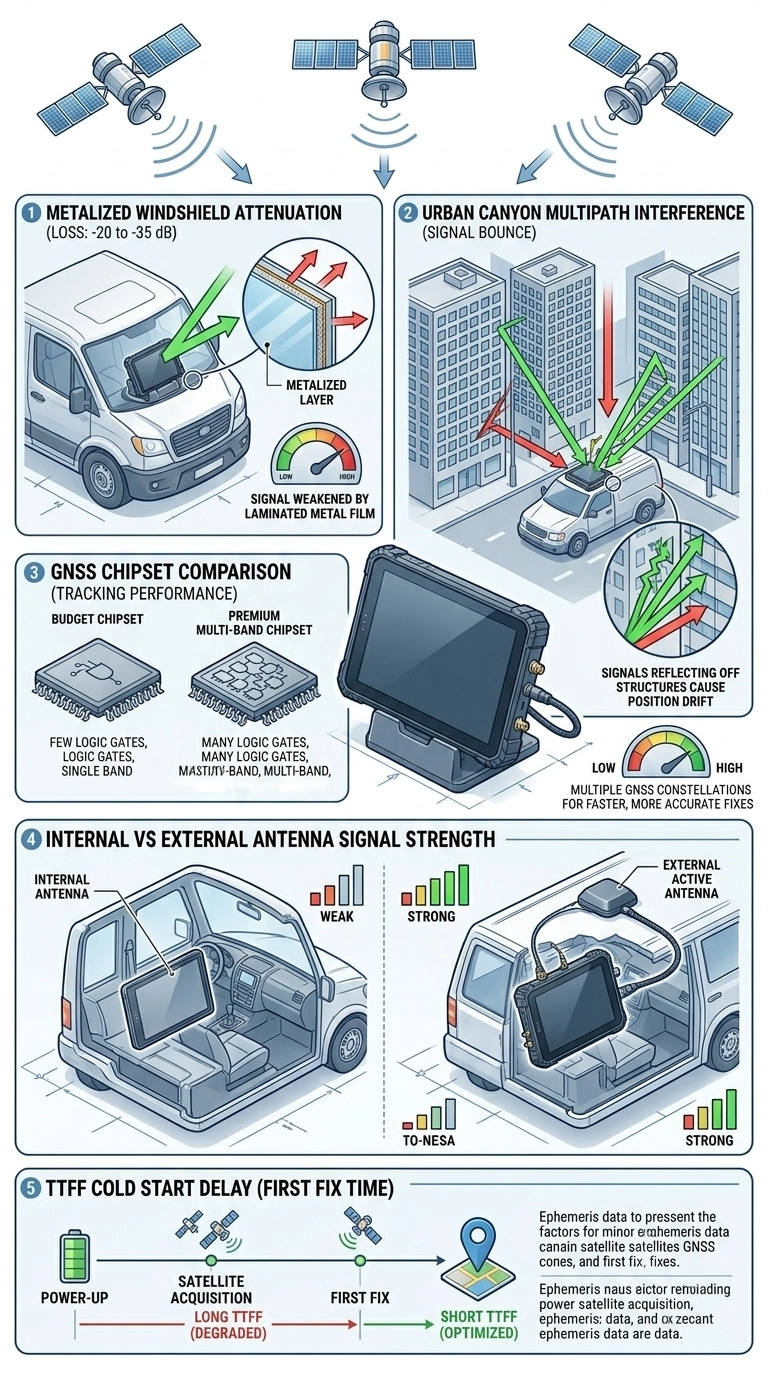
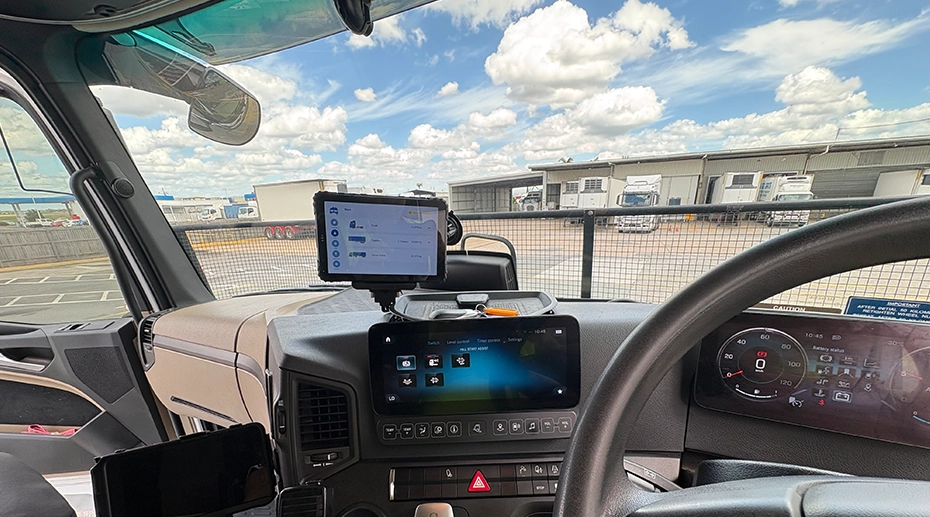
Many modern commercial trucks and buses have windshields with a metalized oxide coating — applied for solar heat rejection and UV protection. This coating is electrically conductive and acts as a partial Faraday cage. GPS signals at 1.57542 GHz (L1 band) are particularly vulnerable: the wavelength is short enough that the metalized layer can attenuate the signal by 15-25 dB. That's enough to drop a usable 35 dB-Hz signal to an unusable 15 dB-Hz — the GNSS chip can't maintain lock.
The problem is often intermittent: the tablet gets a GPS lock outdoors, the driver docks it in the cab, and the signal drops. Or the GPS works on overcast days but fails in direct sunlight — because the windshield coating's attenuation varies with temperature and angle of incidence. This makes it one of the most difficult GPS problems to diagnose because it can't be reproduced on a bench.
Diagnostic Check
Compare GPS signal strength (C/N0 ratio) with the tablet outside the vehicle vs mounted in its normal dashboard position. A drop of more than 10 dB-Hz strongly suggests windshield attenuation. Use a GNSS analysis app that displays per-satellite C/N0 values — don't rely on "GPS signal: good/weak" indicators in consumer apps.
Hardware Solution
External GPS antenna. An active external antenna mounted on the vehicle roof bypasses the windshield entirely. Most fleet tablets support external GPS antenna input via SMA or MCX connector — but this must be specified at procurement. The antenna should be an active type (powered by the tablet's GNSS module through the antenna port) with an LNA gain of 20-30 dB to compensate for cable loss. Position the antenna with a clear 360° sky view, at least 30 cm from other antennas.
2. Multipath Interference: When the GPS Signal Arrives Twice
What's Actually Happening
GPS signals travel 20,200 km from satellite to Earth. When the signal reaches the vehicle, it can take two paths: a direct path (straight from satellite to antenna) and a reflected path (bouncing off a nearby building, truck trailer, or even the vehicle's own roof before reaching the antenna). The reflected signal travels a longer distance, arriving microseconds later than the direct signal.
The GNSS receiver's correlator tries to lock onto the strongest correlation peak — but in a multipath environment, the reflected signal can be stronger than the direct signal. The receiver locks onto the reflection instead of the direct path, calculating a position based on the longer travel time. The result: a position error of 10-50 meters, or a position that "wanders" as the vehicle moves through different reflection environments. This is most common in urban canyons, near large metal structures (warehouses, ports), and when the tablet's internal antenna is mounted close to the vehicle's metal roof.
Diagnostic Check
The telltale sign of multipath is a GPS position that's stable but consistently offset — the vehicle appears to be driving parallel to the actual road, 20-30 meters to one side. If the position error changes dramatically when the vehicle moves from an open area to an area with buildings or large metal surfaces, multipath is likely. GNSS chipsets with multi-correlator designs (tracking both direct and reflected signals) report multipath metrics — check your GNSS module's NMEA output for signal quality indicators.
Hardware Solution
External antenna with ground plane. A roof-mounted antenna with a metallic ground plane (the vehicle roof itself, or a dedicated ground plane disc for fiberglass/plastic roofs) improves the direct-to-reflected signal ratio. The ground plane helps reject low-elevation reflected signals while accepting high-elevation direct signals. GNSS chipset selection matters: multi-constellation receivers (GPS + GLONASS + Galileo + BeiDou) have more satellites to choose from, reducing reliance on any single signal path. Dual-frequency (L1+L5) receivers can measure and cancel ionospheric delay, further reducing the impact of multipath.
3. GNSS Chipset Limitations: Not All GPS Receivers Are Equal
What's Actually Happening
The GNSS chipset inside a fleet tablet determines how many satellites it can track simultaneously, which constellations it supports, how fast it acquires a position after power-on (TTFF — Time To First Fix), and how well it maintains lock under vehicle dynamics. A chipset designed for a smartphone — optimized for battery life and occasional location checks — behaves very differently from one designed for continuous vehicle tracking.
Key specifications that differ between chipsets: number of correlator channels (more channels = better multipath rejection), supported constellations (GPS-only vs GPS+GLONASS+Galileo+BeiDou), sensitivity for cold/warm/hot starts, and update rate (1 Hz is standard for fleet tracking; 5-10 Hz enables accurate speed and heading calculation). A chipset with poor sensitivity will lose lock under tree cover, in urban environments, or during heavy rain — all conditions that attenuate the already-weak GPS signal.
What to Look For in a Fleet-Grade GNSS Chipset
Multi-constellation support: GPS L1 + GLONASS + Galileo + BeiDou. More satellites = faster TTFF, better accuracy in obstructed environments, and redundancy if one constellation has degraded coverage.
Tracking sensitivity below -160 dBm: This determines whether the receiver can maintain lock on weak signals — critical for in-vehicle use where the antenna is inside a metal cabin.
SBAS support (WAAS/EGNOS): Satellite-Based Augmentation Systems provide correction data that improves positional accuracy from 5-10 meters to 1-2 meters in regions with SBAS coverage.
External antenna support: The chipset must support an active external antenna input — not all GNSS modules expose this, even on devices with an SMA connector. Verify the antenna port is connected to the GNSS module, not just present on the enclosure.
4. Internal vs External Antenna: The Biggest Single Factor in Fleet GPS Reliability
What's Actually Happening
An internal GPS antenna — the kind embedded inside the tablet chassis — is always compromised in a vehicle deployment. It's inside a metal-walled cabin. It's behind a windshield that may have a metalized coating. It's surrounded by other electronics generating EMI. It has no ground plane. And its orientation relative to the sky changes every time the driver adjusts the tablet angle on its mount.
An external GPS antenna solves all of these problems simultaneously: it's outside the vehicle cabin with a clear sky view, it can be positioned optimally for satellite visibility, it has a ground plane (the vehicle roof), and it's typically an active antenna with a built-in LNA that amplifies the signal before it travels through the cable to the tablet.
Internal vs External Antenna Comparison
MDT865 GPS Enhancement — External Antenna & USB Receiver Setup
See the signal strength difference an external antenna makes in a real vehicle installation
External antenna setup for high-precision GPS — real-time vehicle tracking and telematics integration with MDT865 rugged tablet.
5. Time to First Fix (TTFF): Why Your GPS Takes Minutes to Lock After a Reboot
What's Actually Happening
When a GNSS receiver powers on, it needs to download two pieces of data from the satellites before it can calculate a position: the almanac (coarse orbital data for all satellites, valid for weeks) and the ephemeris (precise orbital data for each satellite, valid for about 4 hours). This data is transmitted at only 50 bits per second — it takes 12.5 minutes to download a complete almanac and 30 seconds for each satellite's ephemeris.
If the tablet has been powered off for more than 4 hours, the ephemeris data is stale and must be re-downloaded. This is called a cold start. In a vehicle environment with weak signals, downloading ephemeris data can take several minutes — during which the tablet has no GPS position. For ELD compliance, those minutes of missing location data create a log gap. For dispatch systems, the vehicle is invisible.
Hardware and Software Solutions
AGPS (Assisted GPS): The tablet downloads ephemeris data over the cellular network instead of waiting for the satellite broadcast. Reduces cold-start TTFF from minutes to seconds. Requires cellular connectivity — ensure the tablet's data connection is established before the GNSS module needs ephemeris data.
Backup battery on GNSS module: A small battery or supercapacitor on the GNSS module maintains the real-time clock and almanac data in memory while the tablet is powered off. Allows a hot or warm start instead of a cold start after short power interruptions — critical for vehicles that shut down the tablet with the ignition.
GNSS chipset with multi-GNSS support: More constellations mean more satellites broadcasting ephemeris data simultaneously — reducing the time needed to collect sufficient data for a position fix.
GPS Problem Diagnosis Quick Reference
Frequently Asked Questions
Why does my tablet's GPS work perfectly outside the truck but lose signal when docked?
The most common cause is a metalized windshield coating that attenuates GPS signals. Compare the GPS signal strength (C/N0) outside vs inside the vehicle. A drop of more than 10 dB-Hz indicates windshield attenuation. The solution is an external active GPS antenna mounted on the vehicle roof — it bypasses the windshield entirely.
Does an external GPS antenna really make that much difference?
Yes — it's typically the single most impactful hardware change for fleet GPS reliability. An external active antenna with a clear sky view can deliver 40-50 dB-Hz signal strength compared to 25-35 dB-Hz from an internal antenna inside a vehicle cabin. That 15-20 dB difference is the margin between reliable tracking and intermittent signal loss.
How many GNSS constellations does my fleet tablet need?
At minimum: GPS L1 + GLONASS. Ideally: GPS + GLONASS + Galileo + BeiDou. Each additional constellation adds satellites in view — reducing TTFF, improving accuracy in obstructed environments, and providing redundancy. For fleet deployments in regions with SBAS coverage (WAAS in North America, EGNOS in Europe), ensure the chipset supports SBAS corrections for sub-2-meter accuracy.
Do TOPICON MDTs support external GPS antennas?
Yes. TOPICON MDT platforms support external active GPS antennas via SMA connector, with the GNSS module configured to power the antenna's built-in LNA. For deployments requiring high-precision positioning or operating in environments with known GPS signal challenges, external antenna configuration is recommended. Contact our engineering team for antenna selection guidance →
Troubleshooting GPS Issues in Your Fleet Deployment?
TOPICON rugged MDTs support external active GPS antennas, multi-constellation GNSS chipsets, and AGPS for fast time-to-first-fix — engineered for reliable location tracking in vehicle deployments.
Related Troubleshooting & Hardware Resources