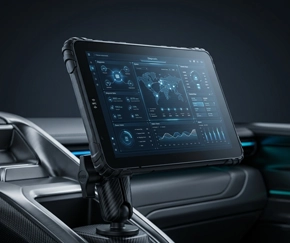
One Device, Two Roles — How a Slim 17mm Tablet with Quick-Release Dock Eliminates the Need for a Second Device
Most fleet deployments end up with two devices per vehicle. One fixed vehicle mount terminal bolted to the dash. One handheld for pre-trip inspections, signature capture, and off-vehicle tasks. Two devices to procure. Two devices to manage. Two devices to replace. But when the in-vehicle tablet is slim enough to grab and go — 17mm thin with a one-hand quick-release dock — the second device becomes unnecessary. Here's how that changes fleet hardware economics and driver workflow.
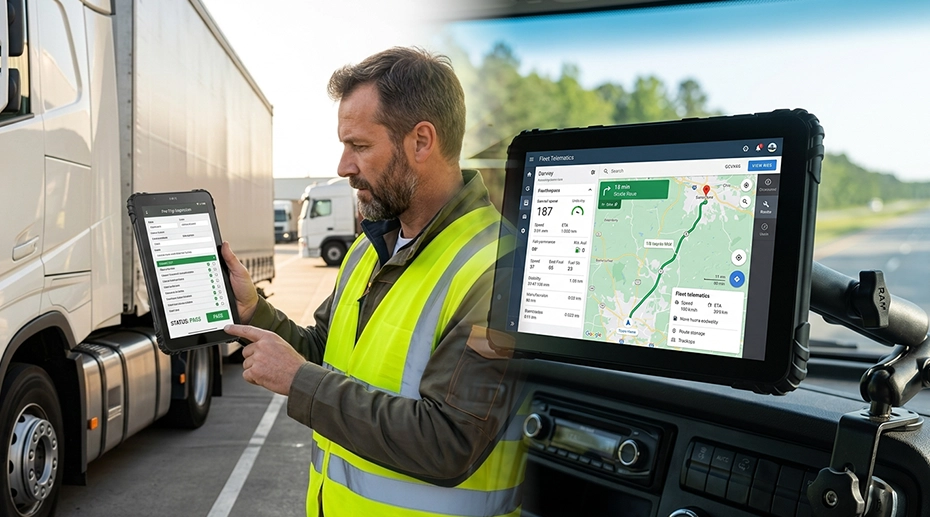
Table of Contents
Field Observation
System integrators deploying fleet solutions in Europe consistently report the same hardware pattern:
Two SKUs to procure, two batteries to manage, two MDM enrollments
Drivers often skip the handheld and revert to paper checklists
Paper records never make it into the digital system
About the Author
TOPICON Hardware Engineering Team
Specialists in vehicle-grade tablet design, docking station engineering, and fleet deployment workflow optimization for system integrators across European and North American markets.
The Two-Device Problem: Why Most Fleet Deployments Carry Unnecessary Hardware
Walk through a typical fleet vehicle deployment and you'll find two computing devices. One is mounted on the dash — a fixed terminal that runs dispatch, navigation, and ELD compliance software. The driver can't remove it without tools. The other is a handheld device — carried outside for pre-trip inspections, used to capture signatures at the delivery point, or shared between drivers during shift handovers.
Two devices means two procurement cycles, two sets of accessories, two MDM enrollments, two battery management routines, and two replacement schedules. For a fleet of 100 vehicles, that's 200 devices to manage instead of 100 — doubling the total cost of ownership before factoring in the operational friction of keeping both devices updated and synchronized.
The root cause is physical. Traditional vehicle-mounted tablets are thick — 22mm to 28mm — and their docks are designed for permanent installation. They're not meant to be removed. So the fleet buys a second device for the jobs the first one can't do. Vehicle mount tablets with quick-release docks break this pattern by making the in-cab device the same device that goes outside.
Part 1: Why 17mm Changes What a Fleet Tablet Can Do
A tablet that lives permanently in a vehicle dock has no size constraint — it can be as thick as needed. But a vehicle mount terminal designed for quick-release deployment must balance dock security with one-hand removal, which imposes strict limits on weight, thickness, and mechanical complexity. A tablet that a driver grabs and carries for a 15-minute pre-trip walkaround inspection cannot be bulky. 17mm is the threshold where a rugged tablet transitions from "vehicle equipment" to "personal device."
In a truck cab, 5-10mm of extra thickness matters more than it seems. The space between the steering wheel and the A-pillar is narrow. A 25mm tablet mounted on a RAM arm protrudes further into the driver's peripheral vision and creates a larger blind spot. A 17mm tablet sits flatter against the dash, reduces the risk of knee contact during entry and exit, and looks intentional rather than improvised.
This is also relevant for ECE R21 compliance in European commercial vehicles — the regulation governing interior projections in truck cabs. A slimmer device mounted closer to the dash surface presents a lower risk profile in the event of sudden deceleration.
Part 2: Quick-Release Dock — One Hand, One Second, No Tools
A slim tablet is only half the equation. If removing it from the dock requires two hands, a screwdriver, or wrestling with a stubborn latch, drivers won't do it — no matter how thin the device is. The dock mechanism itself determines whether the tablet becomes a dual-role device or remains a de facto fixed terminal.
Dock Removal Comparison: What Drivers Actually Experience
Bolt-Down Fixed Terminal
Requires tools to remove. Typically 4-6 bolts. Tablet never leaves the vehicle. Driver must use a separate device or paper for any off-vehicle task.
Latch-Lock Dock
Tool-free removal, but requires two hands and a specific motion (push tab + lift). Drivers remove it occasionally, but not for quick tasks.
One-Hand Quick-Release Dock
Single motion, one hand — grab and go. Tablet transitions from in-cab terminal to handheld inspection device in one second. Driver uses the same device for everything.
The one-hand quick-release mechanism is the critical enabler. It reduces the friction of undocking to nearly zero — which means drivers actually do it, every time, as part of their normal workflow. For fleet management tablet deployments, this single mechanical feature can determine whether the fleet operates with one device per vehicle or two.
Part 3: Why European Pre-Trip Inspections Make the Quick-Release Dock a Requirement, Not a Luxury
Under EU Regulation 165/2014 and Directive 2014/47/EU, commercial vehicle drivers in Europe are required to perform daily walkaround checks before departing — inspecting tyres, lights, mirrors, brakes, load securing, and documentation. These checks must be recorded. They cannot be done from the driver's seat.
The industry's response to this requirement has been fragmented:
Paper Checklist
Driver fills out a paper form during the walkaround, then manually enters the data into the in-cab system afterward. Double work. Paper gets lost. Compliance records are incomplete.
Dedicated Handheld Device
Fleet purchases a separate rugged handheld for inspections. Driver carries two devices. Two procurement and maintenance cycles. MDM manages two separate fleets of hardware.
One Device: Quick-Release Dock + Slim Tablet
Driver undocks the tablet with one hand, completes the digital checklist during the walkaround, re-docks when back in the cab. One device. One MDM enrollment. One battery to manage. No double data entry.
For fleet operators running under EU compliance requirements, the quick-release dock isn't a convenience feature — it's a hardware architecture decision that directly impacts compliance workflow efficiency. A vehicle mount tablet that stays bolted to the dash guarantees that the fleet will need a second device for inspections.
Part 4: Shift Handover — When the Tablet Moves Between Drivers
In multi-shift fleet operations — waste management, last-mile delivery, regional logistics — the vehicle runs 16-24 hours per day with two or three drivers rotating through the same cab. Each driver needs to log into the system with their own credentials, review their assigned route, and confirm the vehicle's condition from the previous shift.
With a fixed terminal, this means every driver shares the same physical device. Personal settings, Bluetooth pairings, and app configurations persist between users. With a quick-release dock, each driver can carry their own tablet — dock it at the start of their shift, undock it at the end. The device is personal. The dock is shared.
This architecture also simplifies maintenance: if a driver's tablet needs service, only that driver is affected. The vehicle and its dock remain operational for the next shift. Compare this to a fixed terminal failure — the entire vehicle is out of service until the hardware is replaced.
TOPICON's 17mm Slim Fleet Tablet Lineup with Quick-Release Docks
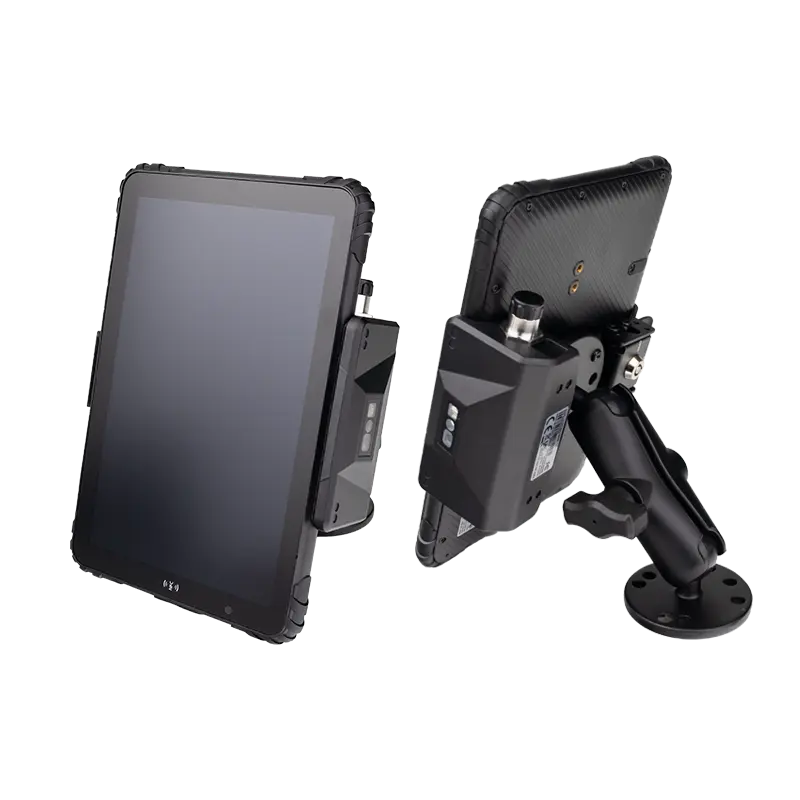
Every 8-inch and 10-inch rugged tablet in the TOPICON fleet hardware lineup shares a common physical profile: 17mm thickness with a one-hand quick-release docking system. The difference between models is in connectivity, I/O, and processing — not in form factor or dock compatibility.
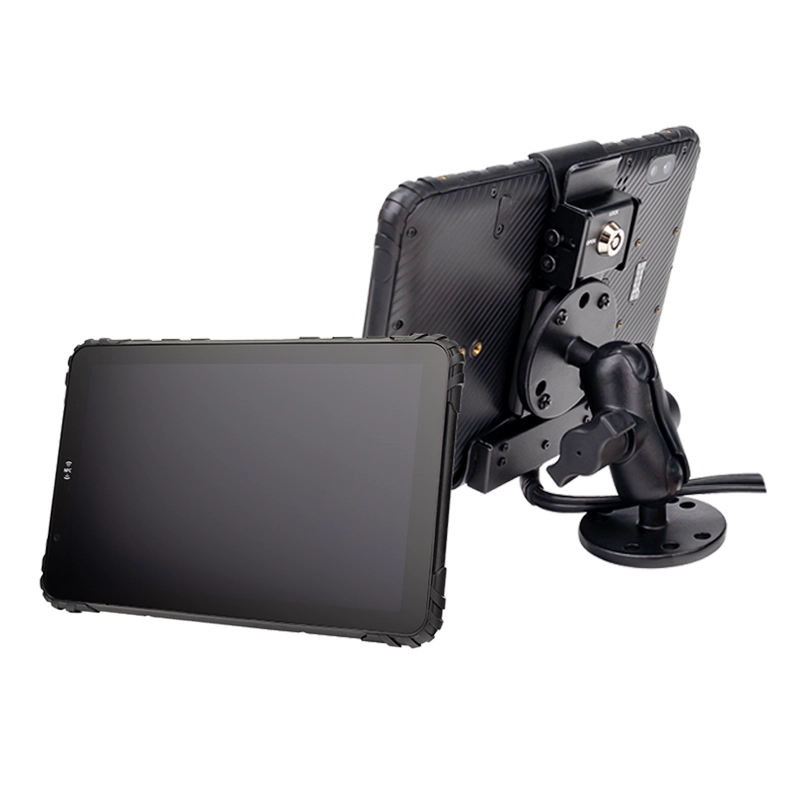
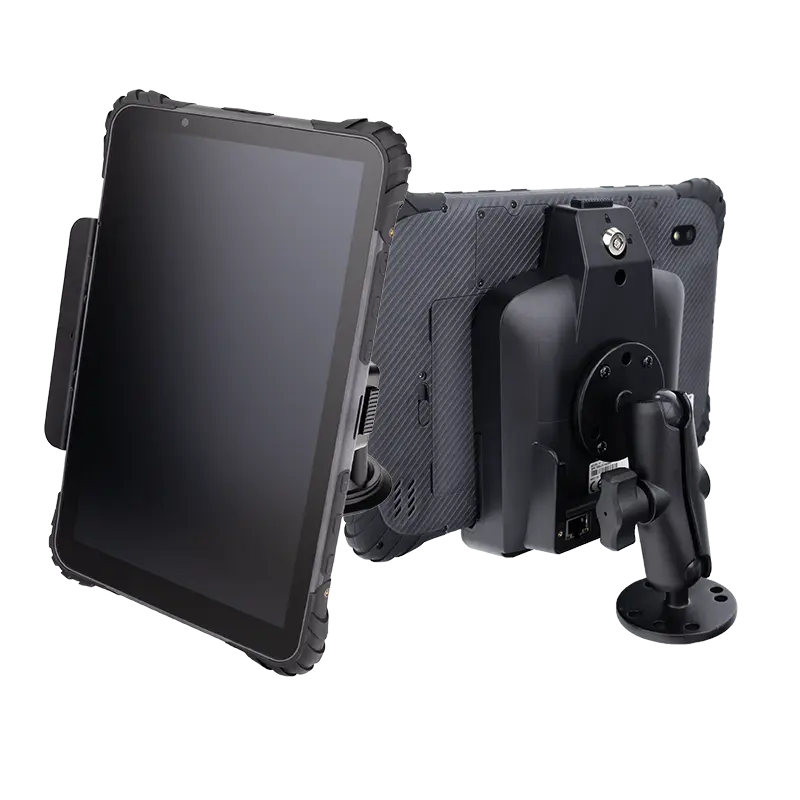
MDT1080 5G
10" · 17mm Slim · IP67
5G + 700-nit Anti-glare
8GB+128GB · Android 14/16
Quick-Release Dock
MDT1065
10" · 17mm Slim · IP67
RS232 + GPIO + M12 Ethernet
GPS + 4G LTE
Quick-Release Dock
All four models share the same 17mm thickness, one-hand quick-release dock compatibility, 9-36V vehicle power with ignition sensing, and Android OS with MDM support. Explore all vehicle mount tablets →
The Hardware Economics: One Device vs Two
The cost argument for a one-device fleet architecture is straightforward, but worth quantifying:
Single Point of Failure
When the pre-trip inspection device is different from the in-cab device, data transfer between them becomes the single point of failure. The driver completes a walkaround on a handheld — but those inspection records must reach the compliance system, the maintenance system, and the dispatch system. If the handheld fails to sync, the inspection effectively didn't happen. If the in-cab terminal fails, the driver has no way to receive route updates. With one device handling both roles, there is no sync step to fail. The data lives on the device that collected it, and it's already in the system the moment the tablet re-docks.
Frequently Asked Questions
Why do most fleet deployments end up with two devices per vehicle?
Because traditional vehicle-mounted tablets are too thick to carry comfortably and too difficult to remove from their docks. Drivers need a device for off-vehicle tasks (pre-trip inspections, signature capture, shift handover), so the fleet purchases a separate handheld. A slim 17mm tablet with a one-hand quick-release dock eliminates this duplication.
What makes 17mm the right thickness for a fleet tablet?
17mm is the threshold where a rugged tablet transitions from "vehicle equipment I leave mounted" to "personal device I'll carry with me." At this thickness, the device feels like a normal tablet in hand, fits in a jacket pocket, and doesn't obstruct the driver's sight line or knee space when mounted. It also reduces the risk profile under ECE R21 compliance for interior cab projections.
How does the quick-release dock work in practice during a pre-trip inspection?
The driver arrives at the vehicle, docks their tablet with one hand (or it's already docked from the previous shift). Before departure, they undock with one hand, complete the digital walkaround checklist while inspecting the vehicle, and re-dock when back in the cab. The entire transition takes one second each way. No second device. No paper. No double data entry. See the vehicle tablet installation checklist for full deployment guidance.
Which TOPICON models support the slim 17mm form factor with quick-release dock?
All current 8-inch and 10-inch models: MDT880 (8" 5G + Dual CAN Bus), MDT865 (8" CAN Bus + ELD), MDT1080 (10" 5G + 700-nit Anti-glare), and MDT1065 (10" RS232 + M12 Ethernet). All share 17mm thickness, IP67 sealing, MIL-STD-810G/H certification, and one-hand quick-release dock compatibility.
Can the quick-release dock be customized for specific fleet requirements?
Yes. TOPICON offers OEM customization for docking stations including custom I/O configuration, locking mechanisms, RFID/NFC reader integration at the dock, and vehicle-specific mounting brackets. See the docking station matrix for 17 pre-configured cradle options.
Deploying Fleet Tablets? One Device Per Vehicle Should Be the Goal.
TOPICON's 17mm slim rugged tablets with one-hand quick-release docks eliminate the need for a second device. From pre-trip inspections to in-cab dispatch, one Android platform handles both roles — reducing hardware procurement, simplifying MDM management, and eliminating data sync failures between devices. Available with full OEM customization for system integrators.
Related Deployment & Hardware Resources