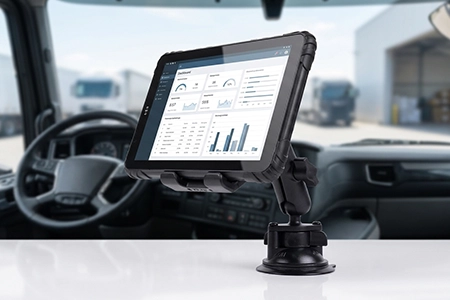
Why Fleet Tablets Should Leave the Vehicle at Night — Battery Protection in Extreme Climates
Industrial-grade tablets are rated from -20°C to 60°C — far wider than consumer devices. But vehicle cabins in extreme climates push well beyond even those limits. A truck cab in Scandinavian winter drops to -35°C overnight. A parked delivery van in Dubai reaches 70°C by midday. No lithium battery thrives in those conditions. The solution isn't a stronger battery — it's a rugged vehicle mount tablets with quick-release docks that leaves the vehicle when the driver does.

Table of Contents
Field Observation
Fleet operators in extreme climates report the same pattern every winter and summer:
Summer: "The battery swelled after one season. The screen separated from the housing."
About the Author
TOPICON Hardware Engineering Team
Specialists in vehicle-grade power architecture, lithium-ion battery behavior across temperature extremes, and rugged tablet deployment for Nordic, Middle Eastern, and Australian fleet operators.
The Gap Between Rated Specs and Real Cabin Temperatures
TOPICON's fleet tablets are rated for -20°C to 60°C operating temperature — a range that covers the vast majority of fleet deployments. This is a genuine industrial specification, far beyond the 0°C to 35°C of consumer tablets. But it's important to understand what this rating means, and what happens when cabin temperatures exceed it.
The takeaway: even an industrial tablet rated for -20°C to 60°C can be pushed beyond its safe limits by extreme cabin temperatures. This is not a design flaw — it's the physics of lithium-ion chemistry. No battery on the market charges safely below 0°C or above 45°C. The solution is architectural, not chemical: get the device out of the vehicle when conditions exceed safe boundaries.
Part 1: Cold Climate — Why -20°C Rated Devices Still Struggle at -30°C
A tablet left in a vehicle overnight in Northern Scandinavia, Canada, or Russia faces temperatures that drop well below the -20°C operating floor. At -30°C, three things happen to a lithium-ion battery:
1. Electrolyte Viscosity Increases
The liquid electrolyte inside lithium cells becomes thick and sluggish. Ion mobility drops dramatically. The battery's internal resistance skyrockets — meaning less usable power reaches the device, even if the cell still holds a charge.
2. Voltage Sag Under Load
When the tablet attempts to boot — pulling peak current to initialize the SoC, display backlight, and radios — the cold battery's voltage sags below the system's minimum operating threshold. The device shuts down mid-boot or refuses to start at all.
3. Charging Becomes Dangerous
Attempting to charge a lithium battery below 0°C causes metallic lithium to plate onto the anode — a permanent degradation that reduces capacity and creates internal short-circuit risk. A well-designed BMS will block charging entirely at sub-zero temperatures.
This is why a -20°C rated tablet can still fail to start on a -30°C morning. The rating means the device operates at -20°C — meaning, once it's running, it can continue to function. But cold-soaking overnight at -30°C is a different challenge. The battery needs to warm up before it can deliver full power, and it absolutely must not be charged until its internal temperature rises above 0°C.
For permanently installed vehicle mount terminals bolted permanently to the dash, there's no way around this. The driver arrives on a -30°C morning, turns on the cab heater, and waits 15-20 minutes for the cabin — and the tablet — to reach a temperature where the battery can function. That's 20 minutes of lost productivity. Every cold morning. For a fleet of 50 vehicles, that's over 400 hours of cumulative downtime per winter.
Part 2: Hot Climate — When a 60°C Rated Tablet Sits in a 70°C Cab
The summer scenario is chemically different but operationally similar. A vehicle parked in direct sunlight in the Middle East, Australia, or the American Southwest creates a greenhouse effect that pushes cabin temperatures 15-25°C above ambient. When the outside air is 45°C, the dashboard can reach 70°C within 30 minutes of parking.
At these temperatures, two threats converge:
Electrolyte Decomposition
Above 60°C, the electrolyte begins to break down, releasing CO₂ and other gases. This is the mechanism behind battery swelling. The hotter it gets, the faster the decomposition.
Charging While Hot = Accelerated Aging
If the tablet is docked and charging in a 70°C cab, the combination of heat + charge current accelerates SEI layer growth. A battery that would last 3 years at 25°C can degrade to 50% capacity in 6 months under these conditions.
A fleet management tablet with ignition-sense power with 9-36V ignition-sensed power partially mitigates this — it stops charging when the engine is off. But the device still sits in the heat. The battery still degrades, just more slowly. The only complete solution is to not leave the tablet in a 70°C cabin in the first place.
Part 3: How 17mm Slim + Quick-Release Solves Both Extremes
The engineering solution is not a "stronger battery" — it's a physical design that makes battery protection part of the driver's natural workflow.
Two Scenarios, One Action: Undock and Go
Winter Morning Routine
The driver kept the tablet indoors overnight — at 15-25°C room temperature, fully charged. They walk to the vehicle, dock the tablet in one second, and it powers on instantly at full performance. No warm-up wait. No cold-start failure. No lost productivity. Same tablet, same dock, zero downtime.
Summer Afternoon Routine
The driver parks, undocks the tablet in one second, and takes it into the air-conditioned depot or office. The tablet never sits in a 70°C cabin charging. The battery never undergoes heat-accelerated degradation. The 60°C rating protects the device during operation — the quick-release dock protects it during storage.
The 17mm slim form factor is critical here. A 25mm thick tablet feels like "vehicle equipment" — drivers leave it in the cab because it's awkward to carry. A 17mm tablet feels like a personal device. Drivers naturally grab it, just as they grab their phone when leaving the vehicle. The engineering enables the behavior, and the behavior protects the battery.
For quick-release tablet mounts for fleet vehicles, climate protection isn't a separate procedure or a training module. It's the natural outcome of a physical design that makes undocking effortless.
Why Fixed Terminals Suffer in Extreme Climates — And What Fleets Do to Compensate
Fleets running traditional bolt-down terminals in extreme climates develop workarounds. None of them are good:
Single Point of Failure
A battery degraded by temperature extremes is a single point of failure that disables every fleet function simultaneously. When the tablet won't start on a cold morning, the driver has no ELD, no navigation, no dispatch communication, and no proof-of-delivery capture. The vehicle is not operational — not because the engine failed, but because the device that manages compliance and logistics can't power on. The cost of that downtime, multiplied across a fleet and a season, dwarfs the hardware savings of choosing a fixed terminal over a quick-release design.
Frequently Asked Questions
If the tablet is rated for -20°C, why does it fail at -30°C?
The -20°C rating means the device can operate at that temperature once powered on. But cold-soaking overnight at -30°C causes the battery electrolyte to thicken, increasing internal resistance. The battery can't deliver enough peak current to boot the device until it warms up. Additionally, charging below 0°C is blocked by the BMS to prevent permanent damage. The solution is to store the tablet indoors overnight — which a detachable in-vehicle tablet with quick-release dock makes effortless.
Can I just leave the tablet in the dock with the heater running?
You can — but idling a truck engine for 20 minutes every cold morning to warm the cab costs fuel, adds engine hours, and may violate local anti-idling regulations. In some European countries, engine idling while parked is subject to fines. A quick-release tablet that comes indoors overnight eliminates this cost and compliance risk entirely.
Does the quick-release dock wear out from daily undocking?
TOPICON quick-release docks are rated for 10,000+ mating cycles. At two dock/undock cycles per day (morning + evening), that's over 13 years of daily use — exceeding the tablet's operational life. The pogo-pin contacts are self-cleaning and designed for high-cycle industrial environments.
Which TOPICON tablets support the quick-release design for extreme climate deployment?
All 8-inch and 10-inch models in the TOPICON lineup — MDT880 (5G + Dual CAN Bus), MDT865 (CAN Bus + ELD), MDT1080 (5G + 700-nit Anti-glare), and MDT1065 (RS232 + M12 Ethernet) — share the same 17mm slim form factor, -20°C to 60°C operating range, and one-hand quick-release dock compatibility. Explore the complete rugged fleet tablet lineup →
Deploying Fleet Tablets in Extreme Climates? Start with a Design That Leaves the Vehicle.
TOPICON's 17mm slim tablets with quick-release docks protect battery life by enabling a simple habit — undock and bring indoors. No idle time. No cold-start failures. No heat-degraded batteries. One device that works at full performance on the coldest mornings and survives the hottest afternoons.