Rugged Tablet Solution for Emergency Response: Reliable Mobile Computing in Disaster Zones
A national emergency response agency deployed rugged vehicle-mounted tablets across their ambulance fleet and field medic teams — replacing consumer tablets that failed under vibration, temperature swings, and rough handling in the patient compartment.
The result: reliable operation from the cab to the rear medical bay — with vehicle docking, continuous 9-36V power, and always-on connectivity for mission-critical coordination.
Customer Background
A national emergency response agency responsible for disaster relief, medical first aid, and rapid rescue missions required a reliable mobile computing solution for their ambulances and field teams. Their existing consumer tablets failed repeatedly — screens cracked during transport, batteries died mid-mission, and devices overheated in fire zone conditions. When a tablet fails during a rescue operation, the cost isn't measured in dollars — it's measured in delayed response and compromised patient care.
Why consumer tablets fail in emergency operations: Ambulances and rescue vehicles expose devices to constant vibration, extreme temperatures, and rough handling during rapid deployment. Consumer tablets lack vehicle power integration — they drain batteries mid-shift and can't stay mounted during emergency driving. Emergency teams need a device that stays powered, stays mounted, and stays operational — no matter the conditions.
Challenges with Consumer Devices in the Field

Extreme Environments
Floods, earthquakes, and fire zones exposed devices to water, dust, impact, and temperature extremes that consumer tablets couldn't survive.

Unstable In-Vehicle Setup
Consumer tablets had no secure mounting in ambulances — devices slid off seats during emergency driving, and USB chargers disconnected from vibration.

Battery Failure Mid-Mission
Consumer tablets relied on battery power alone — devices died during extended field operations with no vehicle charging capability.

Communication Gaps
Remote disaster areas had limited cellular coverage — consumer devices lacked external antenna support for extended connectivity.
Solution: Vehicle-Mounted Rugged Tablets with Continuous Power
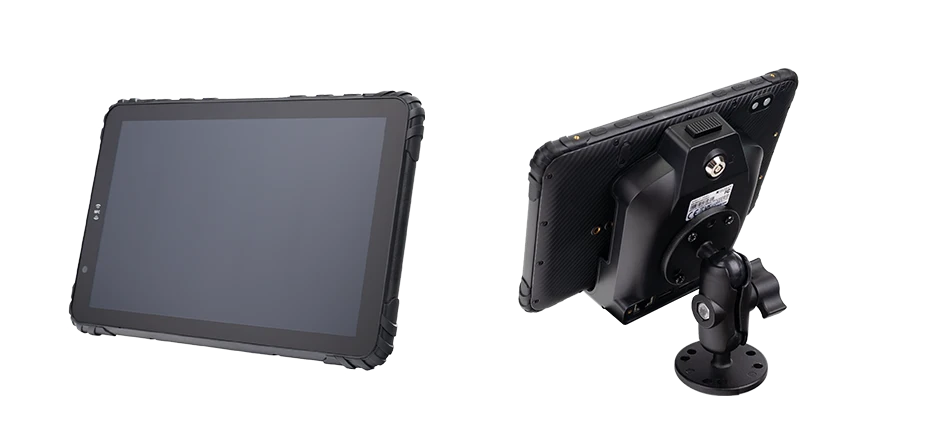
The agency deployed the MDT880 8-inch 5G Rugged Android Tablet across their ambulance fleet and field medic teams. Each vehicle was equipped with a vehicle docking station, RAM-compatible mounting bracket, and 9-36V direct power connection — ensuring the tablet stayed charged, securely mounted, and ready for instant deployment from the driver's cab to the patient compartment.
Vehicle Docking & Power
Securely mounted in ambulances with pogo-pin charging and ignition-sensing power — tablet stays at 100% charge, no battery anxiety during long missions.
Quick-Release for Field Use
One-hand release from vehicle dock — paramedics detach the tablet in seconds for patient-side data entry, then snap it back for charging and navigation.
IP67 Rugged Protection
Operates reliably in heavy rain, flood water, dust storms, and fire zone heat — no protective case needed, no downtime due to environmental exposure.
5G + External Antenna
Always-on connectivity even in remote disaster areas — external antenna support extends cellular range beyond what consumer devices can reach.
→ The vehicle docking system transformed the tablet from a handheld gadget into a mission-critical vehicle computing platform — always charged, always mounted, always ready.
Inside the Patient Compartment: Where the Tablet Actually Works
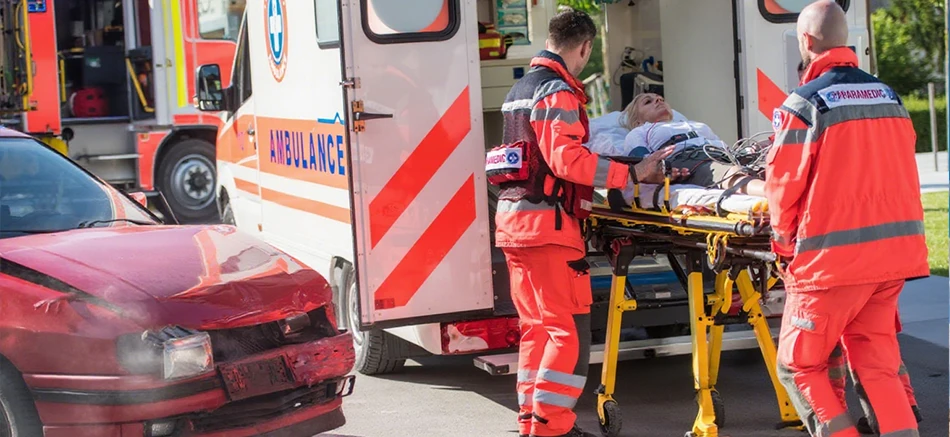
The rear medical bay of an ambulance is a demanding clinical environment compressed into a few square meters. Paramedics work under vibration from the chassis, sudden lateral forces during cornering, and constant time pressure. The tablet in this space is not a navigation screen — it's a clinical documentation tool, a telemetry display, and a communication link to the receiving hospital, all operating simultaneously while the vehicle is moving at speed.
Patient Monitoring Data Entry
Paramedics record vitals — heart rate, blood pressure, SpO₂, Glasgow Coma Scale scores — directly on the rugged tablet while stabilizing the patient. The 1000-nit anti-glare display keeps the screen readable under the ambulance's harsh interior lighting, and the touchscreen responds even when the medic is wearing nitrile gloves.
Hospital Pre-Notification & Telemetry
The 5G connection streams live patient data to the receiving emergency department while the ambulance is en route. The external antenna maintains signal strength in rural areas and concrete-covered urban corridors where consumer devices would drop to no service. The receiving team sees the patient's status before the ambulance arrives at the bay.
Medication & Barcode Verification
Before administering any drug, the paramedic scans the medication vial barcode using the tablet's integrated scanner module. The system cross-checks the drug name, dosage, and expiration date against the patient's record — preventing medication errors during high-stress interventions. This is a workflow consumer tablets cannot execute natively.
Rapid Detach for Patient-Side Use
When the paramedic needs to move closer to the patient — to intubate, insert an IV line, or apply a splint — the quick-release docking system allows one-hand removal from the bulkhead mount. The tablet comes off in under a second, goes to the patient's side for direct documentation, then snaps back into the dock where it resumes charging automatically.
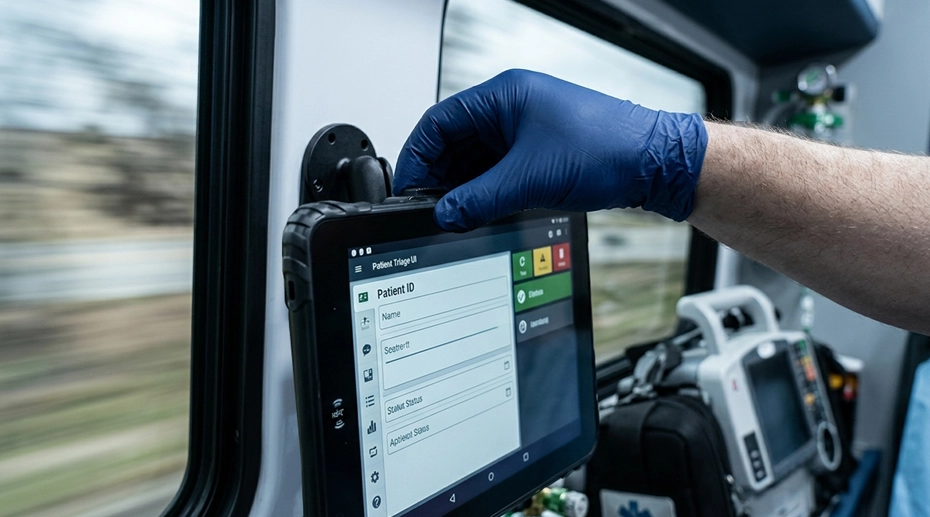
Why the rear bay is harder on hardware than the cab: The patient compartment experiences amplified chassis vibration because it sits behind the rear axle — the same energy that rattles cabinet doors and medical equipment also tests every screw, connector, and solder joint. Consumer tablets with micro-USB or USB-C ports suffer intermittent disconnections from vibration; the MDT880's docking station uses pogo-pin contacts rated for continuous vehicle use, and the 9-36V wide-voltage input absorbs the voltage dips that occur when the ambulance's lights, siren, and suction unit all draw power simultaneously.
What Made the Difference: Vehicle Integration

Vehicle Docking Station
Secure pogo-pin charging in the ambulance — tablet never runs out of battery
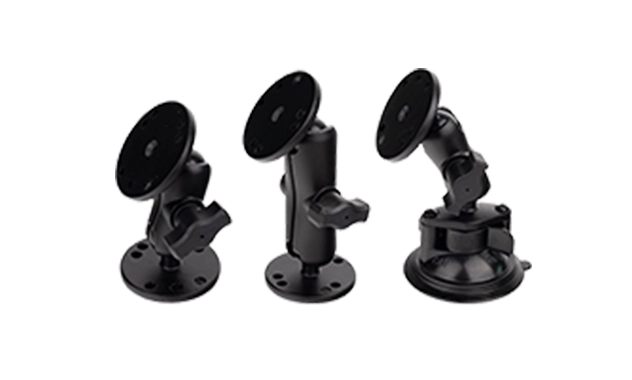
RAM-Compatible Mounting Bracket
Vibration-resistant, stays fixed during emergency driving — quick-release for field use
9-36V Direct Vehicle Power
Ignition-sensing — powers on with the engine, no battery management needed
Results

GPS with sunlight-readable display improved routing through disaster zones

Reliable operation in floods, fire zones, and earthquake sites — zero mission interruptions

Vehicle docking eliminated battery anxiety — tablets always charged and mission-ready

Real-time data sharing between medics, ambulances, and hospital command centers
Customer Feedback
"With rugged tablets mounted in our ambulances, our emergency teams now respond faster and with greater confidence. The vehicle docking system means the tablet is always charged and always secure — even during high-speed emergency driving. In the patient compartment, the paramedics can detach the tablet and take it to the patient's side for real-time documentation, then snap it back into the dock when moving to the next call. They withstand extreme conditions while ensuring seamless access to life-saving patient data and real-time navigation."
— Operations Director, Emergency Response Agency
Conclusion
By deploying the MDT880 rugged tablet with vehicle docking and continuous power integration, the emergency response agency equipped their teams with reliable mobile computing that consumer tablets could never deliver. The combination of IP67 ruggedness, vehicle-mounted docking, and always-on connectivity ensured that when lives depended on technology, the technology didn't fail — from the driver's cab to the patient compartment.
Equipping Your Emergency Response Fleet with Rugged Vehicle Tablets?
TOPICON provides rugged vehicle-mounted tablets with docking stations, continuous power, and IP67 protection — purpose-built for ambulance, fire, and emergency response fleets.