UTV Fleet Operations: Rugged Vehicle Tablets for Off-Road Task Management
UTVs operate where pavement ends — mud, dust, sustained vibration, and direct sunlight are the baseline. This case examines what happens when consumer-grade navigation fails under these conditions, and how the hardware platform choice determines whether route data is complete or fragmented at the end of a shift.
Operating Context
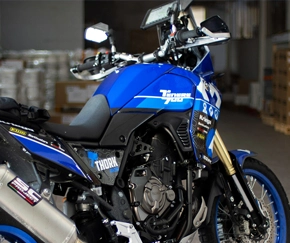
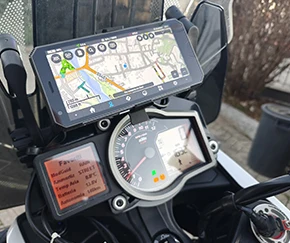
UTVs (Utility Task Vehicles) are deployed across agriculture, construction, forestry, and outdoor maintenance. Each of these environments shares a common set of physical stressors: sustained low-frequency vibration from uneven terrain, airborne particulate ingress, and direct sunlight with no cabin to provide shade. A tablet mounted on a UTV dashboard absorbs the same shock loads as the chassis — there is no suspension isolation between the mounting point and the device.
The operational requirement is straightforward: real-time navigation, equipment monitoring, and task management delivered on a screen that remains readable and responsive through a 10-hour shift in these conditions. When the hardware fails to meet this requirement — when the screen washes out at noon or the GPS fix drops between waypoints — the result is not a user inconvenience. It is a data gap in the route log, a missed maintenance interval, or a task that was completed but never recorded.
What Fails When a Consumer Tablet Goes Off-Road
Vibration-Induced Connector Degradation
UTV chassis vibration transmits directly through solid mounting points. Consumer USB ports develop fretting corrosion at the contact surface within months. The device charges intermittently, then stops charging entirely. The failure is gradual and often misdiagnosed as a battery problem.
Sunlight Washout at 800+ W/m²
In open terrain with no overhead cover, a 400-nit consumer display becomes unreadable by mid-morning. The operator tilts the screen, angles their body to cast a shadow, or abandons the device entirely — reverting to paper notes or memory for the remainder of the shift.
GPS Signal Loss Under Canopy
Consumer-grade GNSS receivers lose lock under tree cover, in narrow valleys, or near equipment structures. The position fix drifts, the route log shows zigzag patterns that cross physical barriers, and the task management system timestamps work at incorrect coordinates.
Particulate Ingress Through Unsealed Ports
Dust and fine particulate enter through exposed charging ports and speaker grilles. Over weeks, internal buildup causes thermal throttling — the SoC reduces clock speed to protect itself from heat that the accumulated dust layer prevents from dissipating.
Hardware Selection: The Engineering Variables
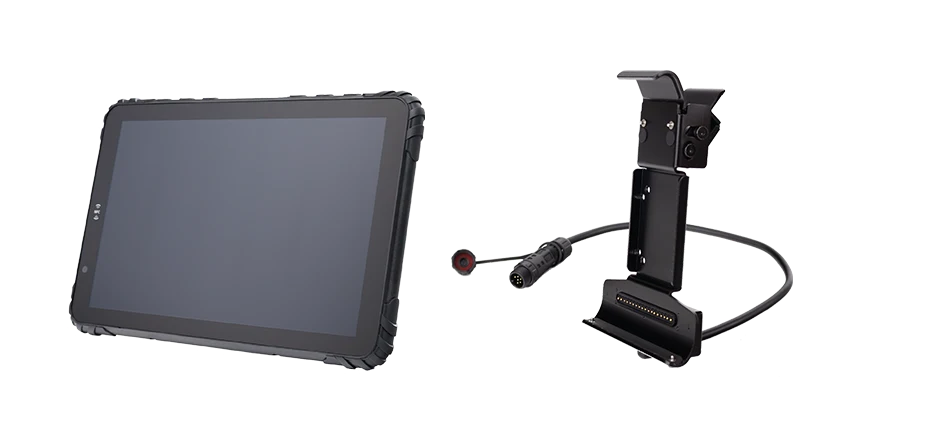
The UTV fleet operator selected rugged tablets across their vehicle fleet. The hardware selection centered on four engineering variables that determine whether a device remains operational through a full shift in this environment.
1. Display: Optical Bonding vs Air Gap
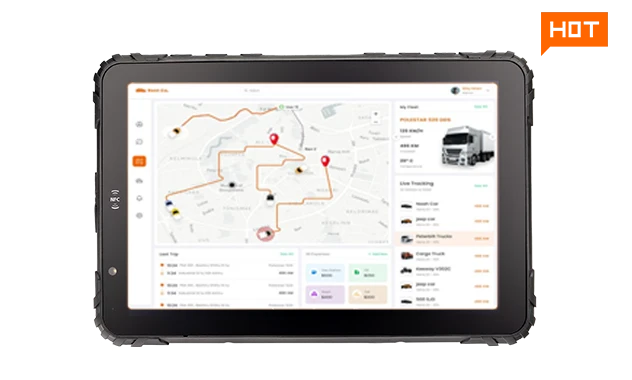
Consumer tablets use air-gap displays — a physical space between the LCD panel and the touch sensor. In direct sunlight, each layer creates a separate reflection plane. The cumulative reflectance makes the screen unreadable regardless of backlight brightness. The deployed tablets use optically bonded displays: the LCD, touch sensor, and cover glass are laminated into a single optical stack, eliminating internal reflection planes. Combined with 1000-nit backlight output, the display maintains readability when ambient light exceeds 800 W/m² — the typical condition on a UTV dashboard at noon.
2. GNSS: Multi-Constellation with External Antenna Support
A single-constellation GPS receiver tracking 6-8 satellites loses position fix when terrain or canopy blocks a portion of the sky. The deployed tablets support concurrent tracking across GPS, GLONASS, BeiDou, and Galileo — 20+ satellites in view simultaneously. When the primary signal path is obstructed, the receiver maintains position using alternate constellations. The SMA antenna port allows an external active antenna mounted on the vehicle roof, bypassing the metal dashboard structure that attenuates internal antenna signals by 8-15 dB. For fleet applications requiring continuous position logging, GPS tracking tablets with external antenna support eliminate the signal dropout that consumer devices cannot solve.
3. Power Architecture: Vehicle DC with Ignition Sensing
Consumer tablets rely on internal batteries charged via USB. On a UTV, the USB connector vibrates loose within weeks. The battery degrades under direct sunlight heat, losing capacity with each thermal cycle. The solution is a vehicle docking station with pogo-pin contacts — no cable to disconnect, no port to wear — delivering 9-36V DC power directly from the vehicle electrical system. Ignition sensing automatically powers the tablet on when the engine starts and initiates controlled shutdown when it stops. The battery remains in the device as backup, not as the primary power source. Vehicle mount tablets with dedicated docking stations eliminate the most common failure point in mobile fleet hardware.
4. Environmental Sealing: IP67 with MIL-STD-810G Validation
IP67 certification means the device withstands complete dust ingress and immersion in 1 meter of water for 30 minutes. For UTV operations, the practical value is not submersion — it is that the seal prevents the slow accumulation of fine dust that causes thermal throttling in unsealed devices. MIL-STD-810G validation (Procedure I, general vibration) confirms the device maintains structural integrity and electrical continuity through the sustained low-frequency vibration characteristic of off-road vehicle operation. The certification applies to specific test procedures, not all possible vibration environments — but Procedure I covers the frequency range that dominates UTV chassis dynamics.
Operational Impact
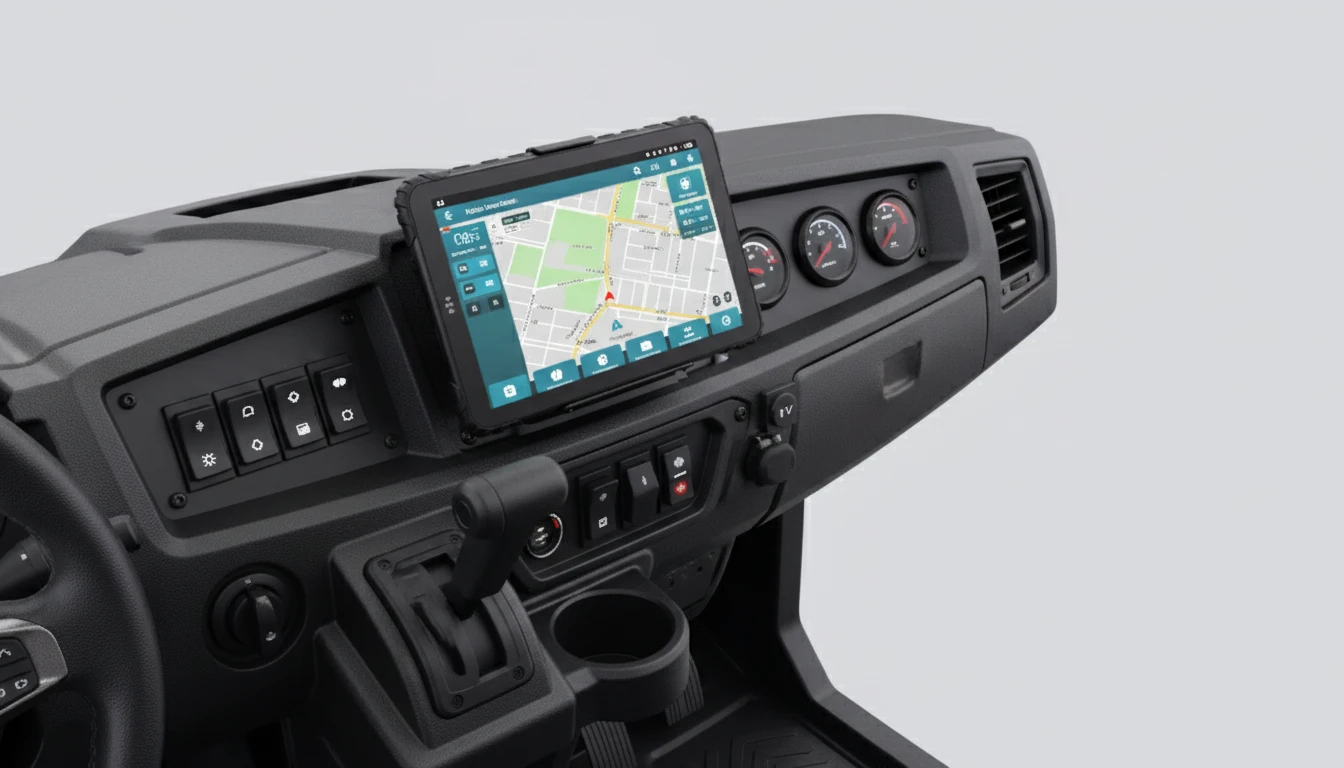
Continuous GPS fix through forested sections and narrow valleys eliminated the fragmented track logs that previously required manual correction.
Sunlight-readable displays eliminated the midday data-entry gap — operators could confirm task completion at the point of work rather than logging retrospectively at the depot.
Pogo-pin docking eliminated the intermittent charging failures caused by USB port degradation under sustained vibration — zero power-related failures across the deployment period.
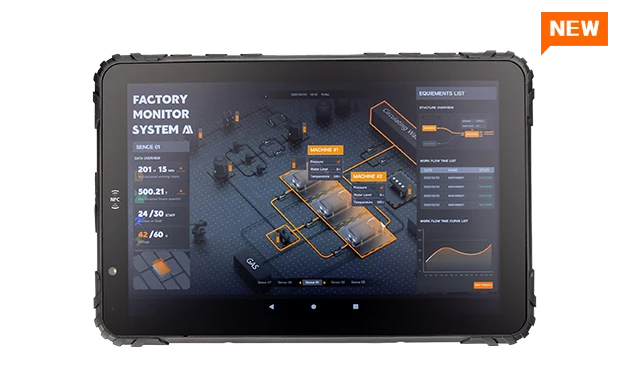
Stable sensor integration via RS232 and CAN bus (MDT865) provided uninterrupted equipment health data, enabling predictive maintenance scheduling that reduced unplanned downtime.
"TOPICON rugged vehicle tablets have transformed how we manage our UTV fleet. Even on rough terrain and in extreme weather, the tablets are reliable and help us complete tasks faster and safer."
— Fleet Operations Manager
For system integrators and fleet solution providers, TOPICON tablets serve as an OEM hardware platform — configurable with custom I/O, private labeling, and pre-loaded software. Explore OEM customization options →
Deploying Rugged Tablets for Off-Road Fleet Operations?
TOPICON provides vehicle-mounted rugged tablets with IP67 protection, sunlight-readable displays, and vehicle docking — purpose-built for UTV, agricultural, and off-road fleet deployments.