Refrigerated Delivery Temperature Monitoring — MDT865 with LoRa Sensors
A regional food distributor runs a fleet of refrigerated vans on daily delivery routes. The compliance requirement is simple to state and difficult to enforce: the cargo area must stay within a defined temperature band for the entire route, and the temperature record must be available for audit. The previous setup used Bluetooth temperature sensors inside the cargo area and a consumer tablet in the cab to display readings. The tablet lost the sensor connection whenever the rear door closed. The temperature log had gaps. The company replaced the setup with MDT865 tablets connected to LoRa sensors.
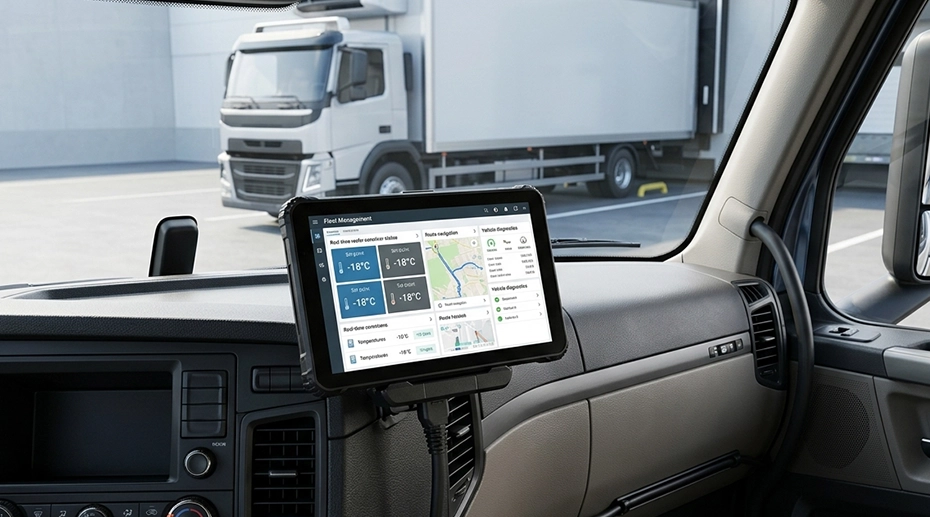
Table of Contents
1. The Operation
The distributor operates 38 refrigerated vans on urban and suburban delivery routes. Each van makes between 15 and 25 stops per shift, with cargo that includes chilled prepared food and frozen items. The temperature band for chilled cargo is 0°C to 4°C. For frozen cargo the band is -18°C or below. Both bands must be maintained from the moment the cargo is loaded until the moment it is delivered.
The compliance requirement comes from two sources. The food safety authority requires temperature records for chilled and frozen food transport, retained for a defined period and available on request. And the distributor's insurance policy requires proof that temperature excursions were detected and acted upon — not just that the truck's refrigeration unit was running. The temperature record must reflect what the cargo actually experienced, not what the refrigeration system setpoint was.
2. Where Bluetooth Failed
The Bluetooth sensor used in the previous setup was a small battery-powered unit with an integrated temperature probe. It was placed near the cargo area ceiling and paired with a consumer tablet mounted on the dashboard. The pairing was established when the driver started the shift. The problem started when the driver closed the rear door.
A refrigerated cargo area is a steel box lined with insulation. When the rear door closes, the sensor is enclosed in a space that attenuates 2.4 GHz radio signals significantly. The Bluetooth connection between the sensor and the cab tablet dropped within the first minute of driving. The tablet displayed the last received reading and marked it as "stale" — but the driver did not have time to monitor a small warning icon while navigating.
The pattern repeated throughout the shift. The sensor reconnected when the driver opened the rear door at a delivery stop, transmitted a burst of buffered readings, and disconnected again when the door closed. The temperature record had gaps that varied in length depending on route timing. For a compliance audit, those gaps were a problem. The distributor could not demonstrate continuous monitoring of the cargo area during transport.
The second problem was the number of sensors. A single Bluetooth sensor reports one temperature. Cargo areas of this size have a temperature gradient — colder near the evaporator, warmer near the rear door. The distributor wanted three sensors per van to capture the gradient. Bluetooth supports multiple simultaneous connections, but the pairing and management overhead becomes impractical at three sensors per vehicle across 38 vehicles. The vehicle power and integration architecture that supports multiple sensor types is what made the migration possible.
3. Why LoRa Works Through the Wall
LoRa operates in sub-GHz bands — 868 MHz in Europe, 915 MHz in North America — and uses a spread-spectrum modulation technique that trades data rate for link budget. A LoRa packet at 50 kbps can cross distances and penetrate materials that stop a 2.4 GHz Bluetooth signal at 1 Mbps or higher.
The physics that matter here are wavelength and absorption. Sub-GHz signals have longer wavelengths that diffract around obstacles and pass through insulation material with less attenuation than 2.4 GHz. The refrigerated cargo area's steel shell and insulation panels attenuate 2.4 GHz by 20 to 30 dB — enough to break a Bluetooth connection. The same structure attenuates 868 MHz by 6 to 12 dB, which the LoRa link budget absorbs without losing packets.
The result is a persistent connection through the closed rear door. The sensor does not need to reconnect. The tablet receives readings continuously throughout the shift, and the temperature record has no gaps. The distributor's audit trail now shows a continuous log from load-out to delivery, with no manual intervention from the driver.
4. Hardware Configuration
The deployment per vehicle:
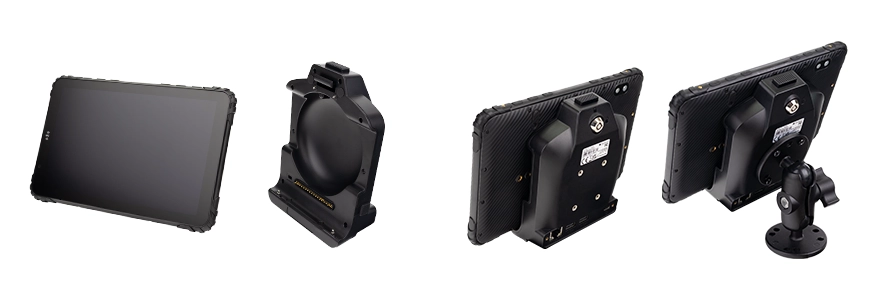
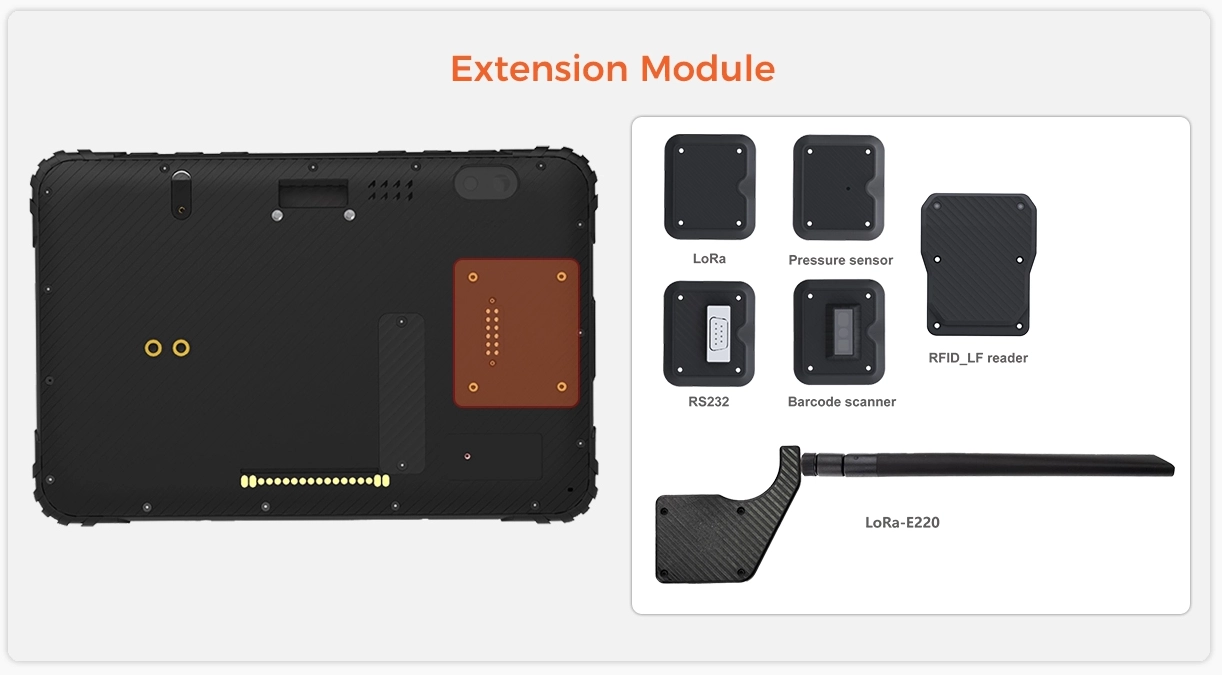
• LoRa module: Expansion module mounted on the rear of the tablet through the device's expansion interface — independent of the vehicle dock
• LoRa antenna: Whip antenna mounted on the vehicle roof, cable routed into the cab
• Temperature sensors: Three LoRa sensor nodes per van, battery-powered, placed at three positions inside the cargo area
• Mounting: RAM mount ball on the dashboard with a short arm
• Power: Direct wire to the vehicle electrical system with ignition sensing
• Software: Custom application that polls the LoRa network at a defined interval and logs readings to local storage and to the fleet backend over 4G
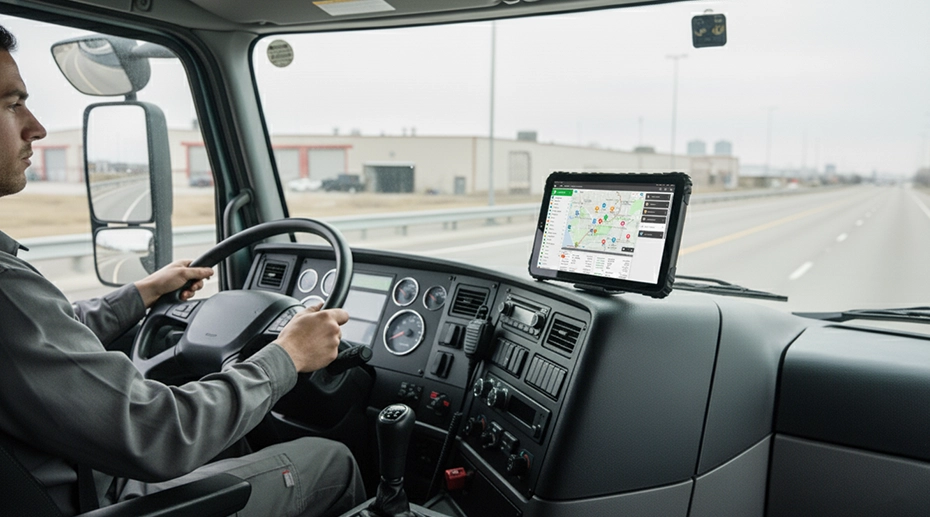
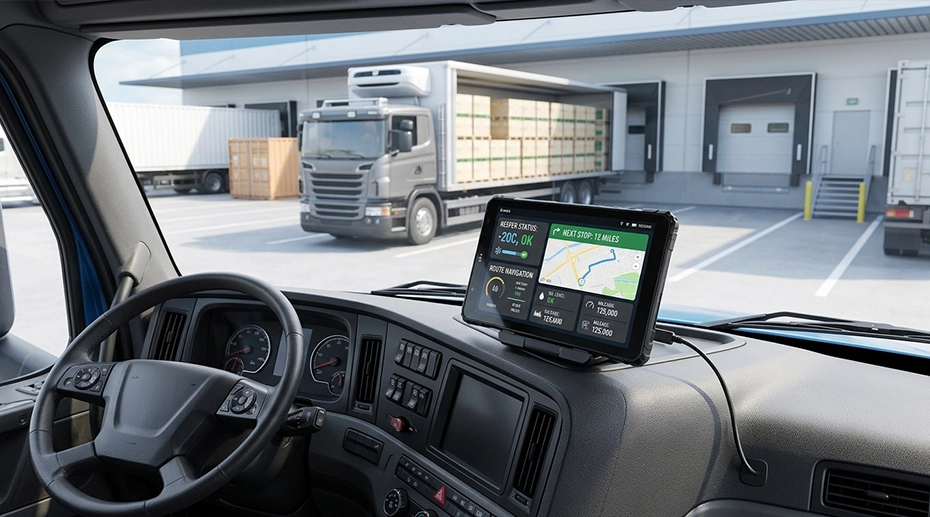
The tablet is a vehicle mount tablet that stays in its dock during the shift. It is not a handheld device. The driver interacts with it through the application interface, and the LoRa communication runs in the background without driver involvement. Because the LoRa module is mounted on the tablet itself rather than on the dock, the module travels with the device if it is moved between vehicles — useful for fleets that share tablets across a larger vehicle pool.
5. Sensor Placement & Multi-Point Monitoring
The three sensors are placed to capture the temperature gradient inside the cargo area. The first is near the evaporator outlet, where the coldest air enters. The second is at the centre of the cargo area at the level where most of the product sits. The third is near the rear door, where the warmest temperature occurs because of heat ingress during delivery stops.
The application displays all three readings on a single screen. The driver sees the actual cargo temperature at each position, not just the setpoint of the refrigeration unit. When a delivery stop opens the rear door, the rear sensor reading rises. The driver sees this in real time and knows the temperature is recovering as the door closes and the van resumes.
The multi-point monitoring also supports a diagnostic function. If the rear sensor shows a higher reading than the centre sensor for an extended period, this indicates either an issue with door seals or a refrigeration unit problem. If the front sensor shows a lower reading than the centre sensor by an unusual margin, this indicates a possible evaporator icing problem. The data feeds back into a maintenance workflow that catches developing issues before they cause an excursion. For deployments that also monitor vehicle electrical behaviour, the ground loop and CAN Bus integrity guide covers the vehicle-side signal considerations.
6. Outcome
The migration was completed across the refrigerated fleet. The most significant change was the audit record. Every route now produces a continuous temperature log with no gaps, timestamped and geotagged. When the food safety authority requested records for a specific delivery date, the distributor produced a complete file within minutes.
The second change was driver workload. In the previous setup, the driver was expected to notice a small "stale reading" warning icon and act on it. That rarely happened. In the current setup, the driver sees the actual cargo temperature at three positions continuously, and the application raises a prominent alert if any reading moves outside the defined band. The driver does not need to remember to check anything.
The third change was maintenance visibility. The temperature gradient across the three sensors is logged for every shift. The maintenance team reviews the trend once per week. A developing seal issue or evaporator problem is visible in the data before it produces an excursion. The fleet has reduced unplanned refrigeration maintenance calls since the deployment.
Single Point of Failure
A temperature log with gaps is a single point of failure in a compliance audit. The question is not whether the cargo was kept cold — it is whether the distributor can demonstrate that it was. A Bluetooth sensor that drops its connection every time the rear door closes produces a record that no auditor will accept as continuous. The physical layer — sub-GHz radio through insulated walls — determines whether the compliance record exists at all. This is not a software problem that can be patched. It is a hardware architecture decision made at the procurement stage.
7. Frequently Asked Questions
Why does Bluetooth fail inside a refrigerated cargo area?
A refrigerated cargo area is a steel box lined with insulation. The steel shell and insulation panels attenuate 2.4 GHz Bluetooth signals by 20 to 30 dB when the rear door is closed. The signal level drops below the Bluetooth receiver's sensitivity threshold, and the connection breaks. The sensor can still log readings internally, but they are transmitted to the cab only when the door opens.
What range does LoRa achieve through the cargo wall?
In a refrigerated van, the distance between the cargo area sensor and the cab tablet is less than 5 metres. This is well within LoRa's range for indoor and vehicle applications. The relevant metric is not the maximum range but the attenuation through the vehicle structure. LoRa at 868 MHz or 915 MHz attenuates by 6 to 12 dB through the same structure that attenuates Bluetooth by 20 to 30 dB — the signal reaches the receiver with ample margin.
Does each sensor need its own pairing process?
No. LoRa sensor nodes are addressed by network ID rather than paired one at a time. The tablet's LoRa module is configured with the sensor node identifiers during installation. Once configured, the tablet receives packets from all sensor nodes in the vehicle's network without per-sensor pairing. This is a significant advantage when deploying three or more sensors per vehicle across a large fleet.
Can the same tablet manage LoRa sensors and vehicle CAN Bus data?
Yes. The LoRa module connects through the tablet's rear expansion interface, and the vehicle dock provides the CAN Bus connection. Both data streams are available simultaneously on the same device — for example, logging cargo temperature alongside engine data from the vehicle ECM. The CAN Bus integration architecture covers how vehicle data and sensor data are combined on the same platform.
Deploying Temperature Monitoring for a Refrigerated Fleet?
The radio frequency and antenna architecture determine whether the temperature record is continuous or full of gaps. Request a hardware evaluation kit or discuss the LoRa sensor integration for your fleet.